
HealthValueLab – Value Based Care - Case Competition
Overview
SUMMARY
The Value Based Care Case Competition (VBCCC) is an interprofessional, experiential learning initiative that engages medical students in solving realistic clinical cases with embedded value deficits.
PURPOSE
To encourage the creation of multidisciplinary, interprofessional teams that are guided by faculty familiar with quality improvement processes to apply high-value care (HVC) principles to identify waste, address patient financial harm, and design practical, system-level solutions. VBCCC promotes collaboration, systems thinking, and cost-conscious, patient-centered care across local and national institutions.
WHY IMPLEMENT
To enhance formal training in HVC and cost-conscious decision-making during medical school. The VBCCC addresses an educational gap by providing learners with a structured, hands-on opportunity to engage with real-world challenges related to healthcare cost, quality, and patient experience. The competition further increases awareness of patient financial harm and healthcare inefficiencies, and offers a scalable, replicable framework that can be implemented across institutions to better prepare learners to deliver equitable, patient-centered, and value-driven care.
Implementing a case competition offers several key benefits:
- Bridges the gap between theory and practice: Learners move beyond passive education to actively applying value-based care principles in realistic scenarios.
- Builds systems-thinking skills: Participants learn to identify root causes of waste and design feasible, institution-level interventions.
- Raises awareness of financial harm: The competition highlights the patient perspective, emphasizing the impact of healthcare costs on individuals and families.
STEPS FOR IMPLEMENTATION
Based on input from subject matter experts, quality improvement leaders, and HVC resources, cases are designed with multiple value deficits.
Step 1: Review VBCCC Participant Packet
- Participant packet/case competition website includes pertinent information related to competition background, information about mentors, the competition rubric, and the case itself.
Step 2: Engage HVC Faculty and Seek Sponsorship
- Engage 1-2 faculty interested in HVC and/or have expertise in selected case to improve buy-in and legitimize competition for recruiting participants/teams
- Secure a small sponsorship (monetary prize or other small incentive) to help increase participation (obtained from a student group, an affiliated medical center, the Dean’s office, etc..)
Step 3: Recruit Panel of Judges
- Reach out to experts from your faculty, school leadership teams or health system leadership teams – utilize them to help promote/recruit participants/teams
Step 4: Recruit Participants/Teams
- Reach out to your first and second year classes, as well as faculty of other healthcare programs at your institution – participants may self-organize into teams, ideally including members from different health professions to reflect real-world clinical collaboration
- Promote VBCCC as an experience that could be impactful on a resume or application
- Use several different sources to share reminders for signing up – emails to class, applications such as GroupMe, physical posters/flyers, word of mouth via faculty and judges, etc…
Step 5: Working on the Case as a Team
- Ground teamwork by:
- defining HVC and applying this knowledge to clinical practice,
- describing sources and consequences of waste in healthcare for society,
- describing the problem of financial harm for individual patients,
- identifying specific causes of waste in healthcare at an institutional level,
- creating programs that drive value in complex health systems,
- encouraging regular team meetings (ex. 1x week),
- advising students to select roles for each group of tasks, which allows individuals to work on things that may be in line with their strengths,
- allocating tasks in order to facilitate equal participation by each group member.
- Ground teamwork by:
Step 6: Evaluate/Judge Team Submissions
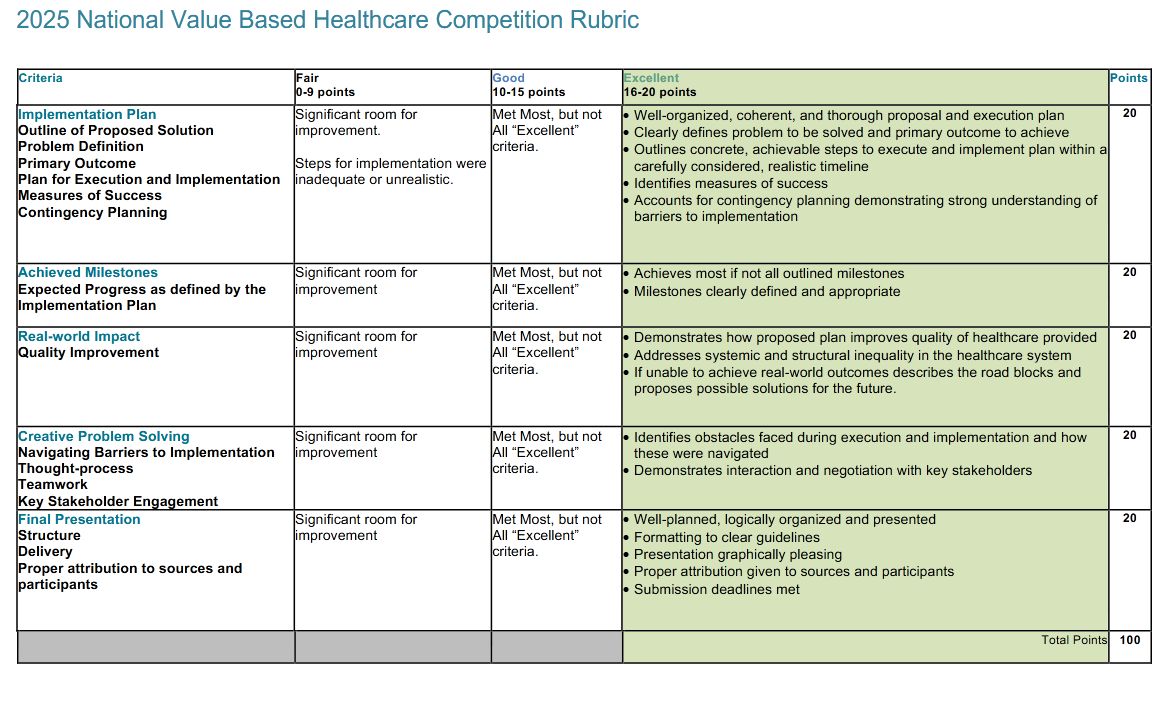
- Provide panel of judges with a standardized rubric for scoring based on 5 core objectives (see helpful resources)
- Teams present their submissions to the panel of judges using same standardized rubric aligned with 5 core objectives (see helpful resources)
BEST PRACTICES & LESSONS LEARNED
- Provide resources (ie Lean Six Sigma, Fishbone diagrams, cost analysis) for teams as they approach the problems presented in the case – most learners within healthcare don’t have a background in systems and process improvement (see helpful resources)
- Get support from the right faculty – faculty advisors should be willing to work with students through the problems of the case and help facilitate solutions that are practical and feasible.
- If possible, a resource that could allow for implementation of the winning team’s idea could be an additional incentive to create modern and realistic solutions.
HELPFUL RESOURCES
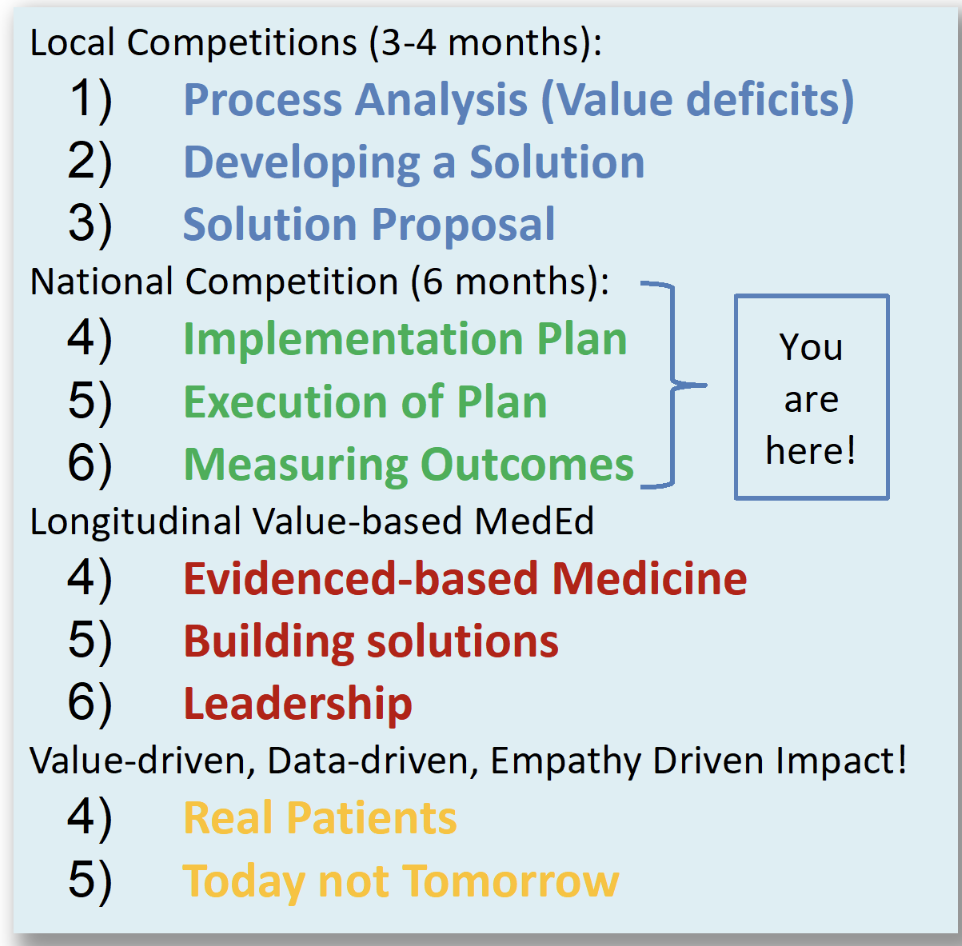
Proposed Competition Timeline
How to Make a Fishbone Diagram: https://augustauniversity.app.box.com/s/kp3palr0fs1mk4lnqwqz1dl9c7e6t6ve/file/1351926529744
Lean Six Sigma Fundamentals: https://augustauniversity.app.box.com/s/kp3palr0fs1mk4lnqwqz1dl9c7e6t6ve/file/1351926527344
Patient and Family Centered Care Resources: https://www.ipfcc.org/about/pfcc.html https://www.youtube.com/watch?v=1k73RL8t_fY
Advice from Previous Winners: https://augustauniversity.app.box.com/s/kp3palr0fs1mk4lnqwqz1dl9c7e6t6ve/file/1351926522544
IMPACT STATEMENTS
“The Value Based Care Case Competition is an excellent way to increase your understanding of the social determinants of health that will make you a more compassionate and holistic physician.” – Tanner Marvets, Member of the Medical College of Georgia Local Case Competition Winning Team
“The VBC case competition was a great opportunity for us to step back and explore what patient centered care actually means to us. As medical students, it’s easy to get tunnel vision: focusing strictly on making the right diagnosis or planning the next assessment…we wanted to look deeper into what patients experience beyond their charts: the day-to-day challenges that often impact their lives the most. The competition really sharpened this lens for us. It also opened the door for us to work with providers at Penn State Health on a pilot study to identify and tackle the barriers in creating a truly patient friendly network.” – 2025 1st place National VBCCC Winners from Penn State
CHAMPIONS
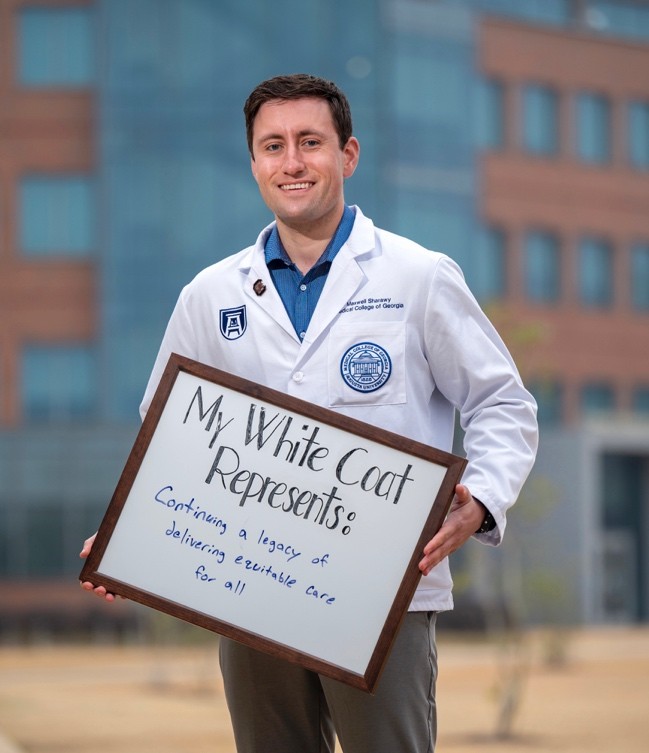
Maxwell Sharawy,
Medical College of Georgia, Class of 2028
Bintaben Patel,
Medical College of Georgia, Class of 2028